
Disclaimer: This post contains affiliate links. If you purchase through these links, I may earn a small commission at no extra cost to you. This helps support my website. I only recommend products I believe offer genuine value based on my research.
Picture this: you’re making breakfast, and you realize you’ve got three egg cartons in the fridge. Which one is the oldest? You’re standing there squinting at tiny date stamps while your pan heats up.
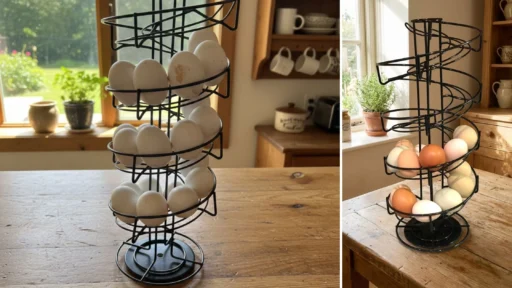
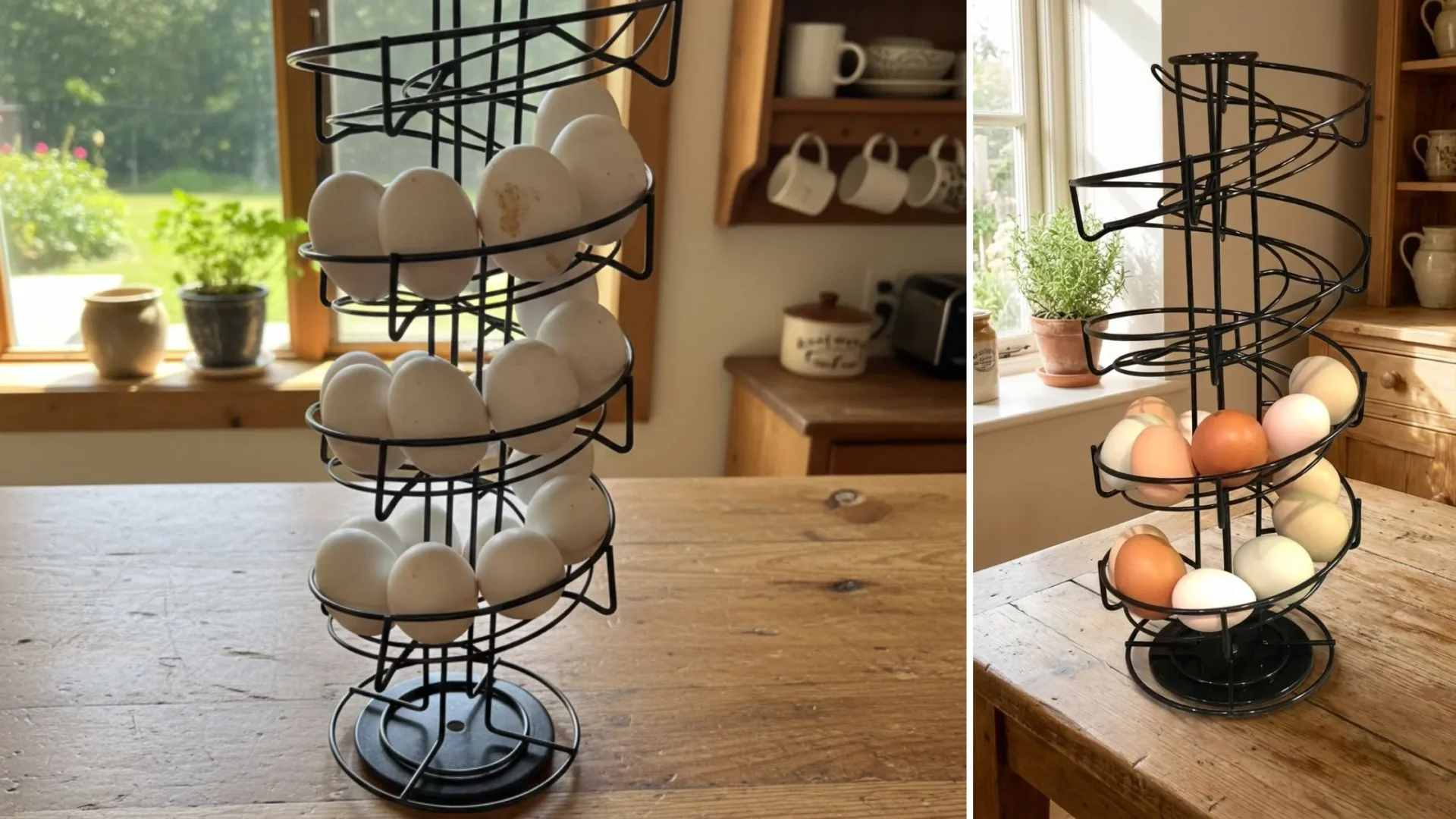
We’ve all dealt with egg storage chaos at some point. That’s why I’m diving into egg rack for kitchen organization reviews, specifically the Toplife Spiral Egg Skelter that keeps showing up in farmhouse kitchens and tiny city apartments alike.
But does this thing actually solve a real problem, or is it just another countertop decoration? Let me break down what I’ve learned.
Quick Overview (The Stuff You Actually Need to Know)
- Holds up to 36 standard eggs (fewer if you use jumbo sizes)
- The spiral design makes older eggs roll to the bottom automatically
- 360-degree rotating base for easy access
- Compact footprint: 6.9 x 6.9 inches (but stands 16.1 inches tall)
- Made from sturdy metal with black finish
- Weighs 1.9 pounds, solid construction
- A non-slip felt bottom keeps it stable
What Exactly Is an Egg Skelter?
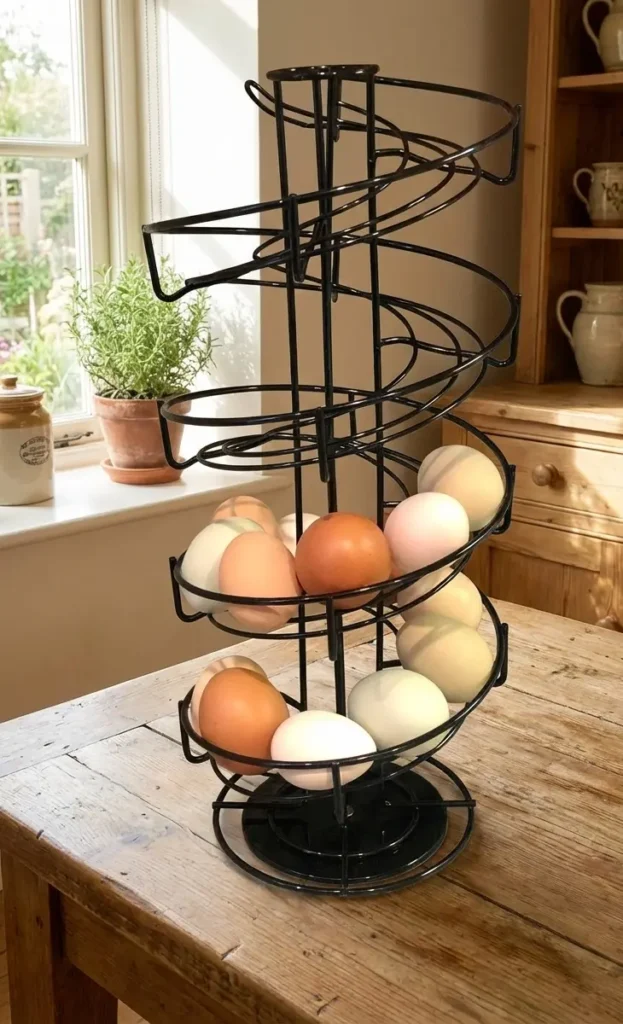
Think of it like a spiral slide for eggs. You add fresh ones at the top, and they naturally work their way down to the bottom as you use the older ones.
The whole point is automatic rotation; you’re always using your oldest eggs first without having to check dates or remember which carton you bought when.
Who’s this actually for?
Based on what people say in reviews, it’s popular with:
- People who raise chickens and need somewhere to store daily egg collection
- Farmers market shoppers who buy eggs weekly
- Anyone trying to declutter their fridge
- Bakers who prefer room-temperature eggs
- Small kitchen owners who need vertical storage solutions
- People who like the farmhouse aesthetic but want it functional
You don’t need to own chickens to benefit from this. Plenty of regular grocery store egg buyers use these just for better organization.
The Features That Make a Difference
Automatic First-In, First-Out System
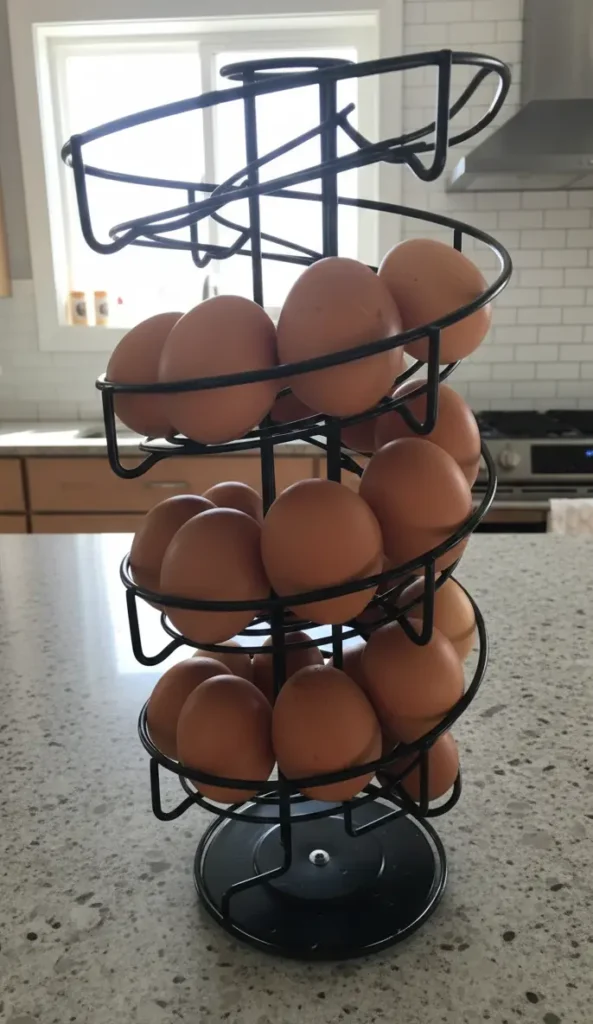
The spiral design isn’t just decorative. When you add eggs at the top, they naturally push older eggs toward the bottom.
This means you’re automatically using eggs in the right order. No date-checking, no guessing, and no accidentally using the fresh ones while week-old eggs sit in the back.
For anyone who buys eggs regularly, this system just makes sense.
Non-Slip Felt Base
When you’re storing three dozen eggs in a tower that’s over a foot tall, stability matters. The felt pad on the bottom grips your counter and prevents sliding.
According to user feedback, even when fully loaded, it stays in place during normal use. One person mentioned having 28 eggs in it with no wobbling issues.
Surprisingly High Capacity
36 eggs in a space that’s less than 7 inches square is pretty impressive. It goes vertical instead of spreading out horizontally.
Keep in mind that jumbo or extra-large eggs will reduce capacity. One reviewer fit 15 jumbo duck eggs plus 9 chicken eggs (24 total). For standard large eggs, you’ll get closer to the full 36.
Small Counter Footprint
At just under 7 inches on each side, this takes up way less space than stacking egg cartons would. The height is the tradeoff at 16 inches; you need decent clearance under your cabinets.
For small kitchens where counter space is limited, going vertical is often the better choice.
Durable Metal Construction
The skelter is made from powder-coated metal wire. At 1.9 pounds, it’s got enough weight to feel solid without being awkward to move.
Bottom Lip Keeps Eggs Secure
The design includes a lip at the bottom that prevents eggs from rolling off when you remove one.
The Real Pros and Cons
What People Love About It
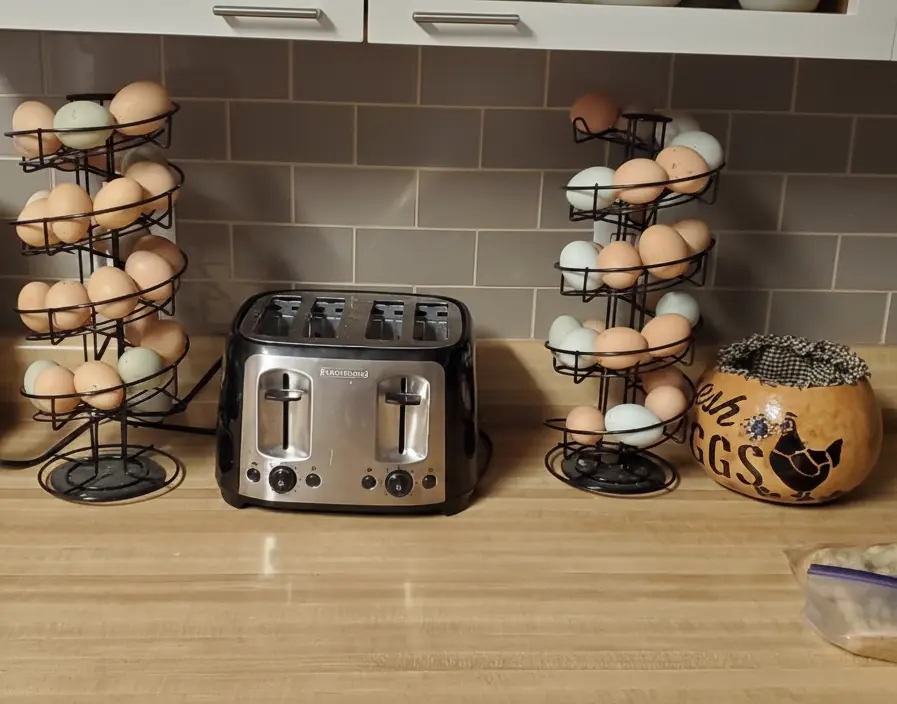
- Major space saver compared to keeping multiple cartons around
- Automatic age rotation means you’re always using eggs in the right order
- Actually looks nice on the counter—not an eyesore you want to hide
- Simple to use right out of the box—no complicated assembly
- Smooth rotation that makes accessing eggs genuinely easier
- Impressive capacity for such a small footprint
- Eggs roll down naturally even with mixed sizes
- Stays stable when loaded—doesn’t tip or wobble easily
- Versatile for different egg sizes and types
The Honest Downsides
- Height might be a problem if you have low-hanging cabinets (measure first!)
- Jumbo eggs reduce capacity to around 24-30 instead of 36
- Cleaning takes more effort than wiping a flat surface—spiral design has crevices
- Works best with relatively clean eggs—not ideal for very dirty farm eggs
- Vertical space might not work for everyone’s kitchen setup
Why Choose This Over Just Using Cartons?
Fair question. Cartons are free, and they work. So why buy this?
The freshness angle: With cartons, you have to actively track which ones are older. The skelter does it automatically through simple physics. Older eggs are always at the bottom.
The space factor: If you’re storing eggs on the counter or in a crowded fridge, three cartons take up a lot of room. This consolidates everything into one compact vertical space.
Room temperature storage: Many people don’t realize that farm-fresh eggs (with their protective coating intact) can be stored at room temperature. If you bake frequently, room-temp eggs work better in recipes. The skelter makes counter storage practical and organized.
Visual appeal: If you get beautiful farm eggs with different colored shells, this displays them nicely. It’s functional storage that also looks intentional.
Convenience: No more digging through the fridge or pantry. Your eggs are visible and accessible in one spot.
Compared to egg baskets or bowls, the skelter gives you actual organization by age. Compared to plastic egg trays, it looks better and handles more eggs. Compared to the fridge carton shuffle, it just eliminates the guessing game.
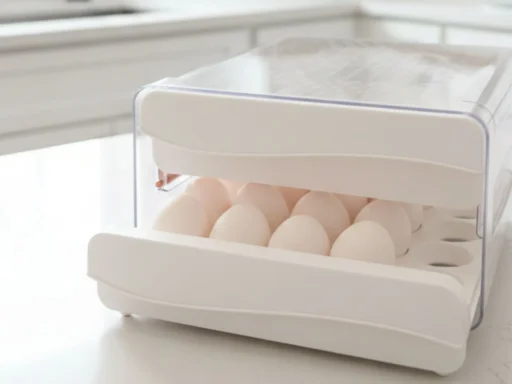
If you’re curious about other egg storage solutions, check out this automatic egg roller organizer rack for kitchen storage for a different approach.
Things to Consider Before Buying
Measure your counter space. Specifically, check the vertical clearance under your cabinets. At 16 inches tall, this needs decent headroom.
Consider your usage rate. Go through a dozen or more eggs weekly? This makes sense. Buy eggs once a month and they sit forever? Fridge storage might be better.
Establish the habit. The system only works if you consistently add new eggs at the top and take from the bottom. It’s simple, but you have to commit to the routine.
Clean eggs before loading. If you’re getting farm-fresh eggs with debris, give them a quick wipe first. The skelter isn’t meant to be a washing station.
Think about your egg variety. If you buy different types (duck, chicken, quail), the spiral works best with medium to jumbo sizes. Very small eggs might not sit properly.
Is This Actually Worth Buying?
Here’s my honest take based on research and customer feedback.
This makes the most sense for:
- People who buy or collect eggs weekly
- Anyone with limited kitchen space who needs vertical storage
- Farm egg enthusiasts who want attractive storage
- Bakers who prefer room-temperature eggs
- Small kitchens where organization is crucial
- People who genuinely forget which cartons are older
It’s probably not necessary if:
- You only buy eggs occasionally
- Your fridge has plenty of space and you’re fine with cartons
- You have very low cabinet clearance
The first-in, first-out rotation is the real selling point. If you’ve ever sniffed eggs wondering if they’re still good or used fresh eggs while older ones went bad, that alone might justify the purchase.
It’s not going to change your life dramatically; we’re talking about egg storage. But it’s one of those small kitchen upgrades that removes a minor daily annoyance. And honestly, sometimes that’s enough.
The price point is reasonable for what you get, and the construction seems solid based on user experiences. If you’ve got the counter space and you use eggs regularly, it’s worth considering.
FAQ: What People Actually Ask
Q: Do eggs really roll down smoothly, or do they get stuck?
They roll down without issues. The spiral is wide enough that eggs naturally move when you remove one from the bottom. Even with mixed egg sizes, gravity does its job.
Q: Will it work for quail eggs?
The design is really meant for medium to jumbo chicken or duck eggs. Very small eggs like quail eggs might slip through the gaps or not sit properly in the spiral.
Final Thoughts: Should You Get This?
Bottom line: if you use eggs regularly and you’re tired of the carton juggling act, the Toplife Egg Skelter does exactly what it promises.
It’s particularly useful for people with backyard chickens, farm egg buyers, small kitchen owners, or anyone who wants better counter organization. The automatic age rotation removes the guesswork from egg freshness, and the compact vertical design saves space.
Is it essential? No. But it’s one of those practical kitchen tools that makes your routine a bit smoother. For the price, it’s a reasonable investment in better kitchen organization—as long as you’ve got the counter height to accommodate it.
If egg carton chaos is a regular frustration in your kitchen and you’ve got 7 inches of counter space to spare, this is worth considering.
I’m Norman from AliDealsHub.com, where I research and share honest recommendations about products that might make your life easier. I dig deep into product details, customer feedback, and real-world use cases to give you the straight story. Questions or feedback? I’d love to hear from you!